
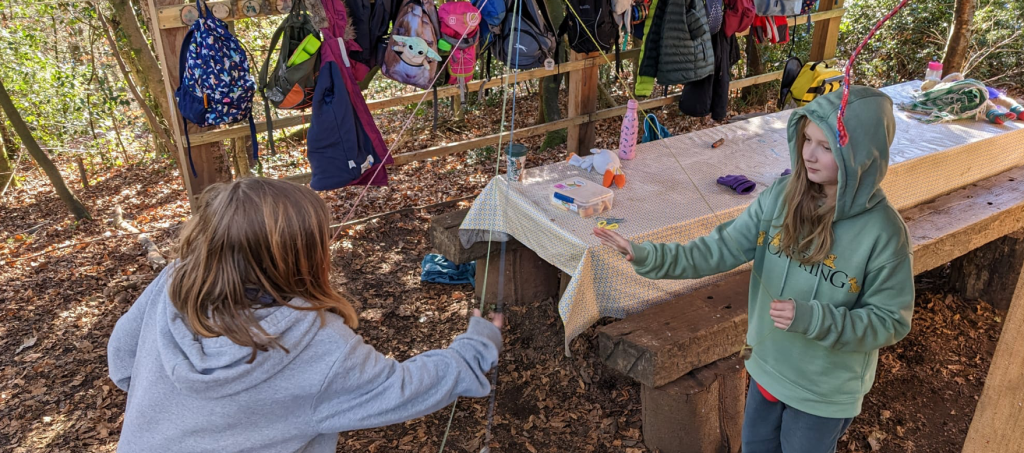
For millions of years, throughout human history, all learning was outdoors. It is only relatively recently that we have decided in our culture to see learning in enclosed classroom spaces as somehow essential. It should not be the case that we educate in such a way as to make ease of teaching the central focus, rather than ease of learning. Outdoor learning is the medium through which the other elements can be brought together; it provides the freedom for self-expression and exploration, the self-discipline to regulate oneself within individual boundaries and the ability to deal with adversity. It provides a long-term view of development; nature cannot be rushed, and it allows for the development of the spiritual, as well as impacting on positive mental wellbeing.
Holistically, outdoor learning combines fluidly all elements of learning; physical, creative, cognitive, and spiritual in a way that other mediums do not. It gives perspective both in time and space and allows a level of contextualisation that does not exist within a classroom setting; it literally connects people with the wider world making what they are doing relevant to their lives and wider experiences. The world is becoming smaller and more accessible at greater and greater speeds, globalisation is a constant in learners’ lives, and connectedness is a daily part of life. By bringing connectedness to a physical level as well as a digital level, learners can be grounded to a sense of place, a community and a support network that allows them to explore a global and digital world without losing a sense of self.
Outdoor learning develops a physical literacy that is increasingly being lost as a rise in obesity has reached arguably pandemic proportions (HM Government 2018). Through an understanding of physicality learners gain a proportionate sense of risk benefit analysis for their capabilities, in a society where ROSPA are saying that risk averse tendencies are a real threat in society (McWhirter 2019) this is a foundational skill learners are in danger of not achieving. Learning how to take appropriate risks is a fundamental capacity for survival and for a society to be in danger of losing this basic life skill is the first step to humanity becoming an evolutionary dead end.
Learners’ wellbeing is integrally tied to outdoor time and open spaces, there are many studies highlighting the value of the outdoors in mental wellbeing (Buckley 2020) and recovery (Ulrich 1984). The mental wellbeing of society is a topic of great concern currently, and without a shift to counteract the high stimulation and stresses of modern society by teaching learners coping strategies and allowing them space and time as respite we cannot expect to see a shift in this rise of mental ill health. It is vital that we instil in the next generation the benefits of being as well as doing.
Lastly, outdoor education is integral to the challenges of the next generation; climate change, desertification, increased frequency of adverse weather (the list could go on) are all real threats for the next generation to deal with. Whilst this remains a sad legacy for us to leave our children, the fact is that this is the next great challenge for the future. People will only protect what they experience and understand, and to deprive learners of outdoor experiences in nature will exacerbate the problem and increase a feeling of helplessness, whereas exposing learners to the natural world will help them understand the problems faced, as well as the necessity to deal with them. It is a foundational principle of education that it should equip learners with the capacity to deal with the world they will inhabit as well as the world they do inhabit. How else can we expect future generations to create and innovate to the betterment of all?
References:
HM Government UK (2018) Childhood obesity: a plan for action. Chapter 2. Published to gov.uk, in PDF format only. www.gov.uk/dh
McWhirter, J. (2019) It’s a bit risky is this! This article first appeared in the RoSPA Safety Education Journal – Spring 2007
Buckley, R. (2020) Nature tourism and mental health: parks, happiness, and causation. Journal of sustainable tourism. Pp. 1409-24.
Ulrich, R. (1984) View through a window may influence recovery from surgery. Science. 27 (224) 420-1.
 Shevek Pring