
Every generation of teachers has seemingly said that education is broken in one way or another, it’s a perennial problem that comes with an older generation trying to pass down knowledge to a new generation that sees the world differently. However, there are a number of flaws in education at the moment that need to be discussed; with an underfunded education system and teachers striking on a regular basis it seems a good time to look at the reasons behind the education system being broken.
Education at the moment is designed to work for everyone apart from those who are supposed to benefit from it. As Tom De Weese puts it “it is designed to work for everyone except the children” (2002). There are a number of really clear examples of this which I will go through one by one. They highlight a number of ways in which the education system has been developed to work for everyone but the children who are made to go through it.
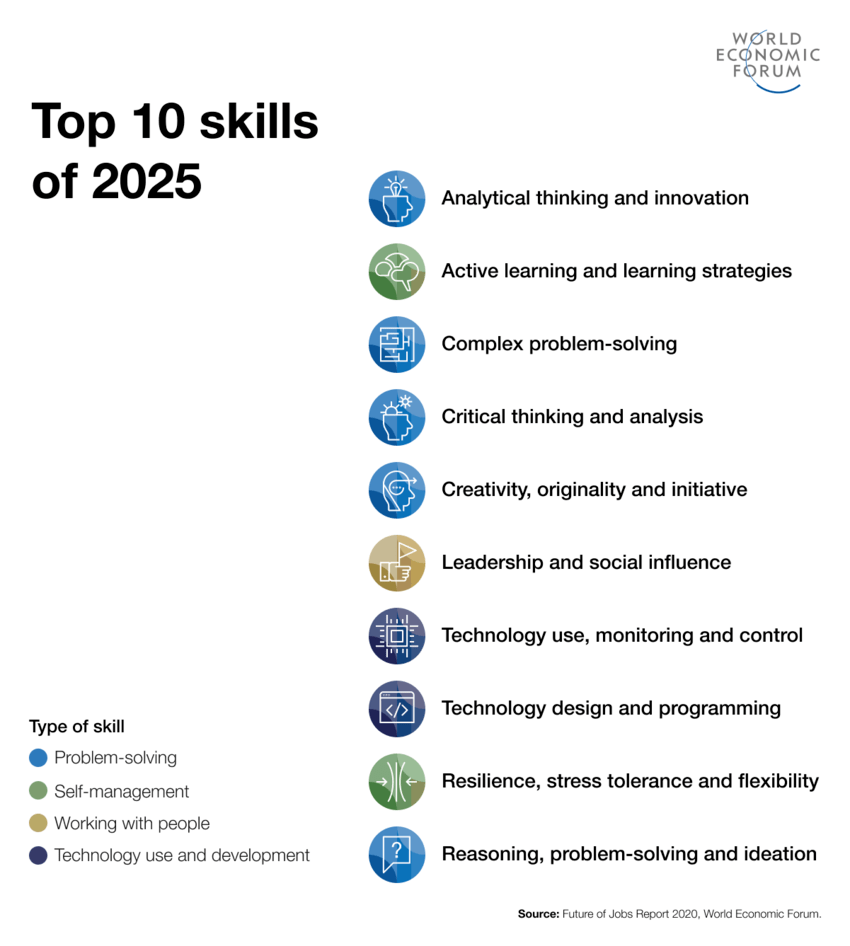
My first point is this; that the current examination process does not actually examine the learning that has taken place. It examines knowledge retention in discrete subjects but does not account for knowledge application. It is also designed to support young people to enter the labour market and be successful in careers but it does not equip learners with the necessary skills for todays world of work. Here is a list of skills for employment from the World Economic Forum, how many of these are well demonstrated through the exam process?
Second point: behaviour management is designed for control not for being safe. Silent corridors is a good example of this, it is designed to make teachers lives easier, to make schools a serene place of quiet productivity, but can you imagine if we applied this thinking to an office full of professional adults! It is clearly control based and for what? Does it really matter if learners talk to each other? Surely this is actually ok? There are many examples of similar areas where control is valued over learner development and enjoyment.
On the subject of joy awe and wonder, we talk a lot about this as educators, but most of these blogs and tweets that I have seen are about learners experiencing this on our terms; educators in control of how and when learners experience these things. Who are we to take over such vast controls over learners lives?
My third point is this; we ‘require’ our learners to engage in what we teach to them, there is no scope for what they are interested in or want to learn. We look at the whole process of learning as one of us as educators placing vital information into an empty vessel. Its no wonder with this approach that we are bemoaning the lack of intrinsic motivation in learners! Would you have any intrinsic motivation if you were forced to sit and learn with no input or say in what you were taught? Of course not! This is what leads us to behaviour systems for control, and extrinsic motivation tactics to ensure learners ‘comply’. It is why we ‘gamify’ education and try and find ways to make it more engaging without asking the key stakeholders, the learners, what they would like to be learning about. I fail to see how this is supportive of learners and it doesn’t seem much like its a system designed to work for learners, more to make educators lives easy! As Andreas Schleicher et. al. of the OECD puts it; we are educating learners to be “second class robots” (2019)
My fourth and final example (but by no means the last example available!) is assessment. Specifically that our assessment processes do two things well, and both are for the benefit of teachers not learners;
- Assessment is designed to support national benchmarking and not the individual learners. It is all too easy to take a national average and apply it to an individual to say they are achieving or failing respectively. This is unhelpful and does not support learners as it is both not an accurate use of the national average, and also because it does not provide the specific support that learners need to improve.
- Assessment looks at what has been learned, how much can one remember, how many components of the curriculum can be recalled. This measures the outcome of what has been taught but it does not support learners to understand and embed the process of that learning. Recall is not anything like application or understanding of context, and recalling specific data does not help learners understand the broader application of their learning throughout their lives. Again, this assessment supports teachers more than learners.
Overall, the fact that learners are the last consideration in the process rather than the centre of the process is one of the fundamental reasons why the education system is failing learners. We build systems, curriculums, hierarchies and teaching practise that all assume that the learner is nothing but a blank slate, and that they all require the same information in the same way. It also assumes that all learners understand information in the same way and so can be assessed for understanding in the same way. It does not take much thinking to realise that these assumptions at the heart of the education process cause many of the issues described above, and many more as well. It is a foundational shift that needs to be made to ensure that learners are placed firmly at the heart of the process of education and learning.
References:
DeWeese, T. and Act, C., 2002. Sustaining nothing, losing everything. The Progressive Conservative, USA.
Schleicher, A., Achiron, M., Burns, T., Davis, C., Tessier, R. and Chambers, N., 2019. Envisioning the Future of Education and Jobs: Trends, Data and Drawings. OECD Publishing.
 Shevek Pring