

So what is the difference? We all hear these terms spoken about and they are in many cases used more or less interchangeably. Well, yes they are all linked, and there is some crossover for sure, but if you look at the diagram below you will see where they all sit in relation to one another.
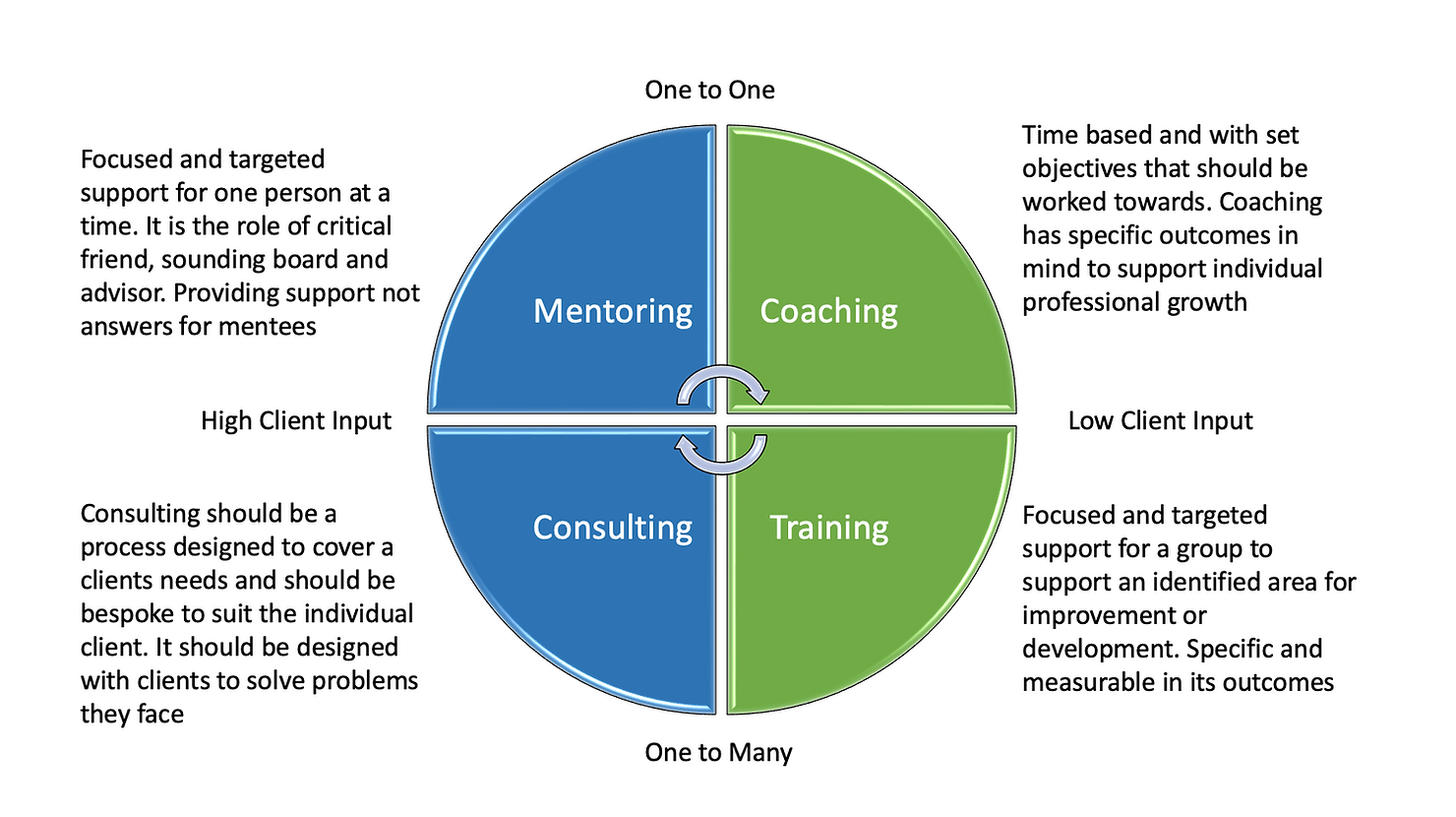
There is a spectrum of support that goes from one to one processes with mentoring and coaching through to a one to many approach with consulting and training. There is also a difference between the levels of client input; for example consulting might include some training packages or delivery, but training would not include consultancy, this is due to the level of client input into these activities.
Whilst training can be bespoke, when it is delivered it is the trainer who controls the process whereas with consultancy there is a high client input into the process all the way through. This level of input from clients makes consultancy unique to each organisation and this is generally what makes the difference both in price to the client and in the level of results you see.
For the one to one models you will see coaching has a lower client input; although there is obviously a lot of input due to it being one to one, with coaching there is a specific focus on solving particular problems, preparing for particular things or closing the gap on particular skillsets. This often makes coaching time or outcome based (coaching is required until a certain result is achieved e.g. a promotion or effectiveness in a role, or is time constrained e.g. preparation of an executive for a step change in an organisation due to a large contract coming in). Coaching is more focussed and can cross over into the one to many model too if you are coaching a whole executive team for example.
Mentoring is probably the most bespoke of the elements, it is one to one and highly personalised; it provides someone with ongoing support and guidance through being a sounding board, critical friend, or through providing examples and guidance. It does not give you the answers, it helps you to grow and develop personally and/or professionally so that you are able to take on and master the challenges you face. It is often a much longer term relationship and can last for years with periods of relatively little contact followed by more intense periods of contact to work through particular issues.
When seeking consultancy, mentoring or coaching it is really important that you are getting a good fit with your organisational culture, or with your own goals. It is definitely a good idea to discuss these things with your prospective coach or mentor before you commit to anything, and any professional will understand this and be happy to meet free of charge to discuss these things before signing you up to an expensive process with you going in blind! Remember in all of these things it is ultimately about your own growth and development so keep in mind who you want to be at the end of the process to ensure you are on the right path.
It is important to remember however that none of these are a silver bullet, none are guaranteed successes, and most of all, none of these are a replacement for psychotherapy or counselling. Being clear in your boundaries both as a practitioner and a client is really key; don’t expect miracle fixes as a client, and don’t overpromise or overstep boundaries as a practitioner. The paradox in coaching, teaching, mentoring and consulting is that if you do your job well, you are embedding skillsets that mean that ultimately you should not be needed in the future. The better you do your job, the better your clients function and succeed. Maybe thats why consultancy has a reputation for being overpriced!
 Shevek Pring