
We are facing unprecedented turnover of teachers and 30% of teachers will leave the profession within the first 5 years (TES). The pay is being disputed but the issues go much deeper. Ultimately the audit culture in education has turned the profession from a vocation into a job. Below are a few of the reasons why the system is broken and unsustainable for teachers.
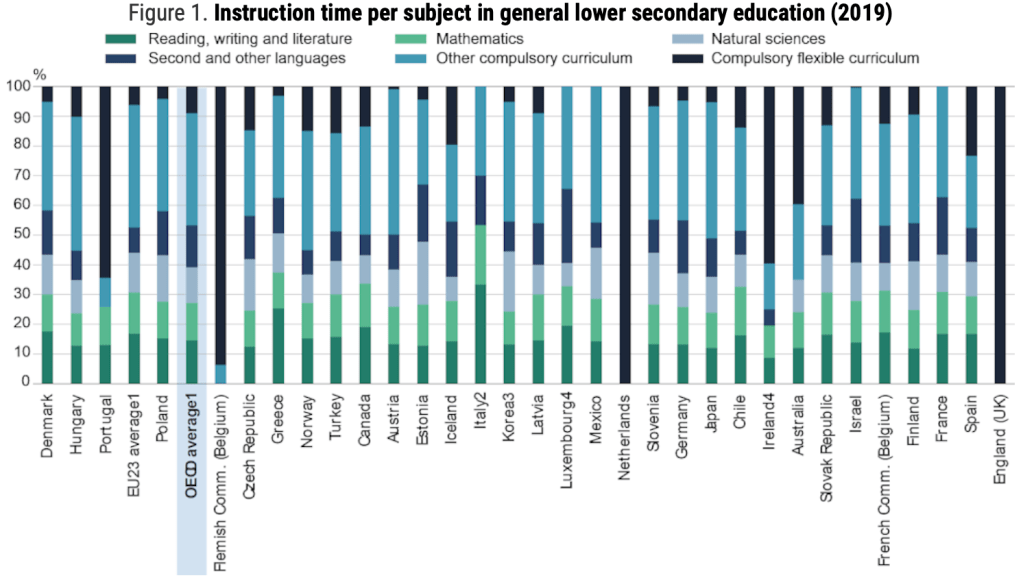
Reason 1: Unmanageable curriculum. The curriculum is full, so full in fact that it cannot be effectively taught. Heres an image from the OECD (2019) that explains this in terms of 4 elements;
- Curriculum Expansion
- Content Overload
- Perceived Overload
- Curriculum Imbalance
Reason 2: Teacher Workload and hidden hours. The UK Government report that 2 thirds of teachers spend over half their working time on non teaching tasks (Gov.co.uk 2023). 56% of teachers and leaders combined said their workload was both unmanageable and too large. The Guardian reported in 2014 that teachers hours were on average 55+ a week and its only got worse since then.
Reason 3: It’s all about the summative assessment and Exams results. We have built a system that doesn’t see teaching as a vocation anymore. It sees teaching as a means to get exam results for schools to move up a league table. It is all about results, and that means a reduction in what is taught, a reduction in opportunities for teaching and learning. Less sports, less music, less arts. We have built a system that has taken the vocation out from under teachers.
Is it any wonder that teachers are leaving in such large numbers, we have a system that has sucked the life out of the profession. There was always some good will from teachers because they believed in what they were doing, I’m not so sure this is true anymore.
We have as an educational industry taken what was once a proud and passionate vocation full of people who were inspired and inspiring, who wanted the best for their learners and who had the capacity and the autonomy to create challenge and differentiate for individual needs, and we have collectively turned it into a bureaucratic juggernaut that has little regard for teachers workload or the overall holistic abilities of learners. Instead of being data driven, it is not driven to meet data.
Sure there have been improvements along the way, it hasn’t been an unmitigated disaster, reading and writing have gone up significantly in PISA scores, and STEM has been better featured through use of technology in teaching. But fundamentally we haven’t improved the experience for teachers or learners, and crucially, we have not as an industry kept up with the demands of the labour market.
There are simple answers to these problems, although they are radical as well as simple; completely overhaul the national curriculum and make it focus on the future skills needs in the workforce instead of subject headings, and then completely overhaul regulation to QA assessment in a radically different way. Lastly, completely abolish league tables (the published versions that lead to reductive practise, if these are kept for data analysis that’s not a concern for me). If we took such a systems wide approach to change, we would be in a position to follow the evidence, keep learner welfare and staff workload in mind whilst still producing a world class education system fit for the future. It is possible, and worthwhile going through the inevitable upheaval to get there. One thing is certain, the system cannot continue as it is. Something has got to change.
References:
TES: https://www.tes.com/magazine/archive/third-teachers-leaving-profession-within-5-years
Gov.co.uk: 2023 https://assets.publishing.service.gov.uk/government/uploads/system/uploads/attachment_data/file/1148571/Working_lives_of_teachers_and_leaders_-wave_1-_core_report.pdf
Guardian 2014: https://www.theguardian.com/teacher-network/teacher-blog/2014/mar/15/working-hours-teaching-profession-secret-teacher
 Shevek Pring