
Welcome to the final episode of our podcast’s inaugural season! In this episode, we’re delving into the realm of pedagogy under the constructivist model of education. Contrary to popular belief, the core principles of pedagogy don’t necessarily have to vanish; they merely require a shift in intent and application. Let’s explore how this paradigm shift in teaching methodology can revolutionize education.
Defining Pedagogy:
Before we delve deeper, let’s define pedagogy. When we talk about pedagogy in teaching, we refer to the methods and strategies educators employ to deliver curriculum content to their students. But under the constructivist lens, pedagogy takes on a different hue—it becomes a vehicle for active engagement and meaning-making.
The Constructivist Mindset:
To effectively adopt a constructivist teaching methodology, educators must cultivate a mindset that aligns with its principles. Professor Alun Morgan eloquently describes the fusion of Content Knowledge and Pedagogical knowledge as Pedagogical Content Knowledge. This highlights the dynamic nature of content knowledge, which adapts to the teaching environment. However, the question arises: Can pedagogical knowledge remain constant? The answer lies in recognizing that the efficacy of pedagogy hinges on the intent behind its use.
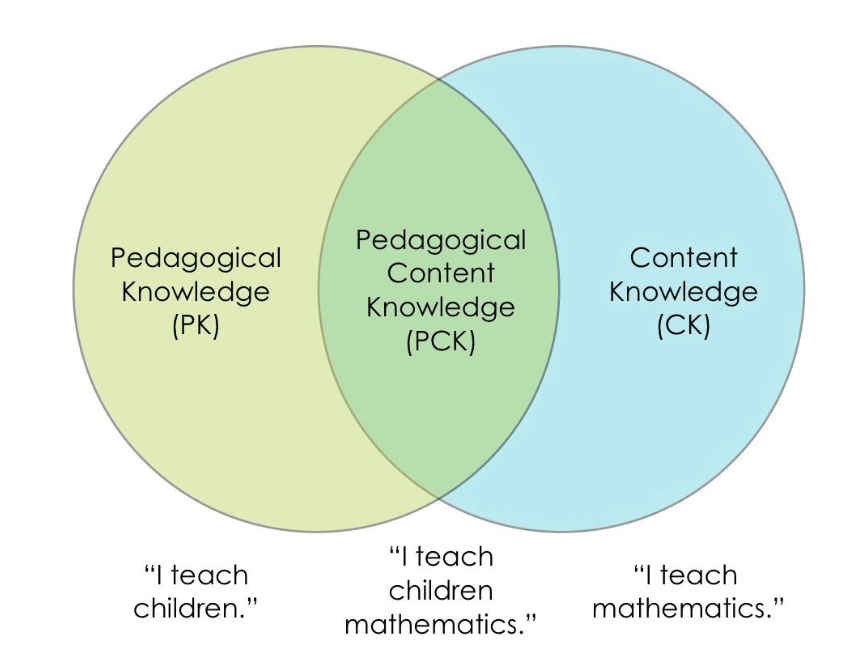
An example here of the PCK as described by Alun Morgan
Principles of Constructivist Learning:
Drawing from the insights of George Hein and educational luminaries like Piaget, Ausubel, Vygotsky, Dewey, and Bruner, let’s outline the fundamental principles of constructivist learning:
- Learning is an active process, where learners construct meaning from sensory input.
- People learn to learn as they learn, constantly constructing and refining systems of meaning.
- Meaning construction primarily occurs in the mind, emphasizing the importance of mental engagement.
- Language plays a crucial role in learning, shaping our understanding and communication.
- Learning is inherently social, intertwined with our interactions with others.
- Contextual factors deeply influence learning, connecting it to our lived experiences.
- Prior knowledge serves as a foundation for acquiring new knowledge.
- Learning takes time and requires repeated exposure, reflection, and experimentation.
- Motivation is indispensable for learning, driving engagement and application of knowledge.
Reimagining Pedagogy:
Despite the paradigm shift proposed by constructivism, current teaching pedagogy can seamlessly align with its principles. However, it necessitates a fundamental shift in the teacher’s mindset—from a prescriptive approach to one that embraces flexibility, creativity, and learner-centeredness. Pedagogy shouldn’t be viewed as inherently flawed but rather as a tool whose effectiveness depends on how it’s wielded.
Worked Examples:
Let’s consider practical examples that illustrate the transformative potential of constructivist pedagogy:
- The Theory of Loose Parts: Encourage open-ended exploration by providing materials and prompting learners to create without predetermined outcomes. This fosters creativity, problem-solving, and collaboration.
- Leveraging Non-Traditional Learning: Recognize the value of unconventional learning experiences, such as exploring educational content through video games. By embracing learners’ interests and empowering self-directed exploration, educators can uncover rich learning opportunities.
Looking Ahead:
As we wrap up this season, it’s evident that the heart of education lies not in discarding pedagogy but in reimagining its purpose. Season 2 will delve deeper into the challenges facing education today, offering insights into navigating this ever-evolving landscape.
In conclusion, the constructivist paradigm invites educators to embrace a mindset shift—to view pedagogy not as a rigid framework but as a versatile tool for fostering meaningful learning experiences. By aligning our intent with the principles of constructivism, we can cultivate a generation of learners equipped to navigate the complexities of the modern world. Thank you for joining us on this journey, and we look forward to continuing the conversation in season 2.
References:
George Hein 1991: http://www.exploratorium.edu/IFI/resources/constructivistlearning.html
Rannikmäe, M., Holbrook, J., Soobard, R. (2020). Social Constructivism—Jerome Bruner. In: Akpan, B., Kennedy, T.J. (eds) Science Education in Theory and Practice. Springer Texts in Education. Springer, Cham. https://doi.org/10.1007/978-3-030-43620-9_18
Gürlen, E. (2012). Meaningful learning and educational environment. Journal of Education and Future, (1), 21-35. Retrieved from https://www.proquest.com/scholarly-journals/meaningful-learning-educational-environment/docview/1504180201/se-2
Piaget Vygotsky and Constructivism: https://citeseerx.ist.psu.edu/document?repid=rep1&type=pdf&doi=7760b21417a16a8feec92f2ecc1646bea92d7a37
Ord, J., 2012. John Dewey and Experiential Learning: Developing the theory of youth work. Youth & Policy, 108(1), pp.55-72.
Parallel paths to constructivism. Piaget and Vygotsky. Susan Pass: https://www.wob.com/en-gb/books/susan-pass/parallel-paths-to-constructivism/9781593111458
Alun Morgan et al.: Lambert, D., Waite, S., Roberts, M. and Morgan, A., 2024. The Sustainability and Climate Change Curriculum Outdoors: Key Stage 2: Quality curriculum-linked outdoor education for pupils aged 7-11. Bloomsbury Publishing.
Shevek Pring White Paper: https://shevekpring.com/books-and-papers/
 Shevek Pring