
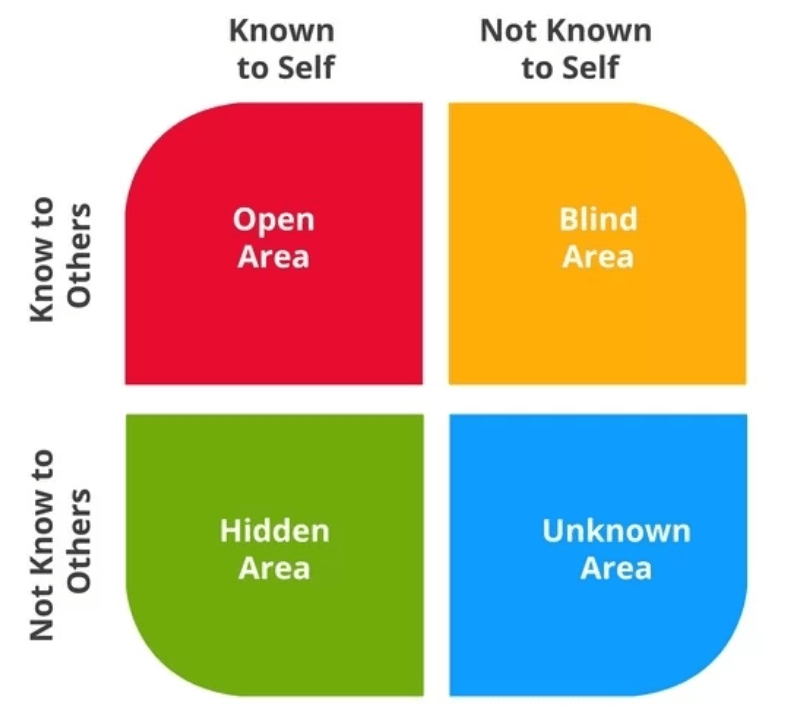
Although the Johari Window in its original form is used as a personality test, and usually in conjunction with the Dream Johari Window, the scope of the tool is much wider than this. It can be used as a self-reflective tool and a powerful aid to identifying areas of personal development that you feel you may need to work on. The basic premise is that you break down the skills, attributes, and traits you have into four categories.
Arena- this is where the attributes you have that are known by everyone go. This is your most open skills and attributes that you most commonly and consciously display in public are housed.
Facade- these are your hidden talents, things you know you are good at, or qualities you know you have but that you rarely if ever share with others.
Blind Spot- these are the skills, qualities, aptitudes, and abilities that others know you have but that you are not aware of.
Unknown- this is the parts of your personality, strengths, skills, and abilities that are unknown to you or anyone else.
There are three main areas and two main aspects that can help to use this tool for personal development. Firstly, there is the unknown section, the things no one knows about you. The only way of drawing these skills and abilities out into either the facade or the blind spot areas is to try and do things you have never done before. Take new opportunities and risks, change the way you work or the hobbies you take part in. Consciously seek out jobs and exercises that will stretch you into areas where you have no prior knowledge, and, as you partake in these, be reflective. Be open to the possibilities, you may excel, you may not, but as long as you are reflective there will be no failure as all you will do is increase your knowledge of yourself. It is important with this that you seek out the opinions of your peers, if you don’t do this and are not open to feedback, you will only succeed in moving potential new skills and undiscovered qualities into the blind spot where they will do you very little good. It is hard to develop yourself based on a set of new skills and qualities that you are unaware you have discovered!
The second part of the process is to actively seek to move skills and qualities that you think will benefit you into the arena from the facade and blind spot, again, you cannot do this alone and collaboration and feedback from peers is critical, as a side-line benefit of this process you will vastly increase your soft skills in the areas of communication, listening and reflection among other things. To actively display these qualities in the arena it is important to practise them regularly. Again, seek out opportunities to use these new abilities even if you are not confident with them, take on collaborative projects with someone who is experienced and use this as a valuable opportunity to learn and grow.
Ultimately, using the Johari Window as a starting point for personal development can be very rewarding and a very useful insight tool that can also tell you a great deal more than what your hidden skills are, especially if used with the Dream Johari Window as well.
 Shevek Pring